
Is Your Event Actually Worth the Money? How to Prove Event ROI (Without Guessing)
Learn how to measure event ROI beyond attendance using the right metrics, clear objectives, sponsor outcomes, engagement data and procurement savings.
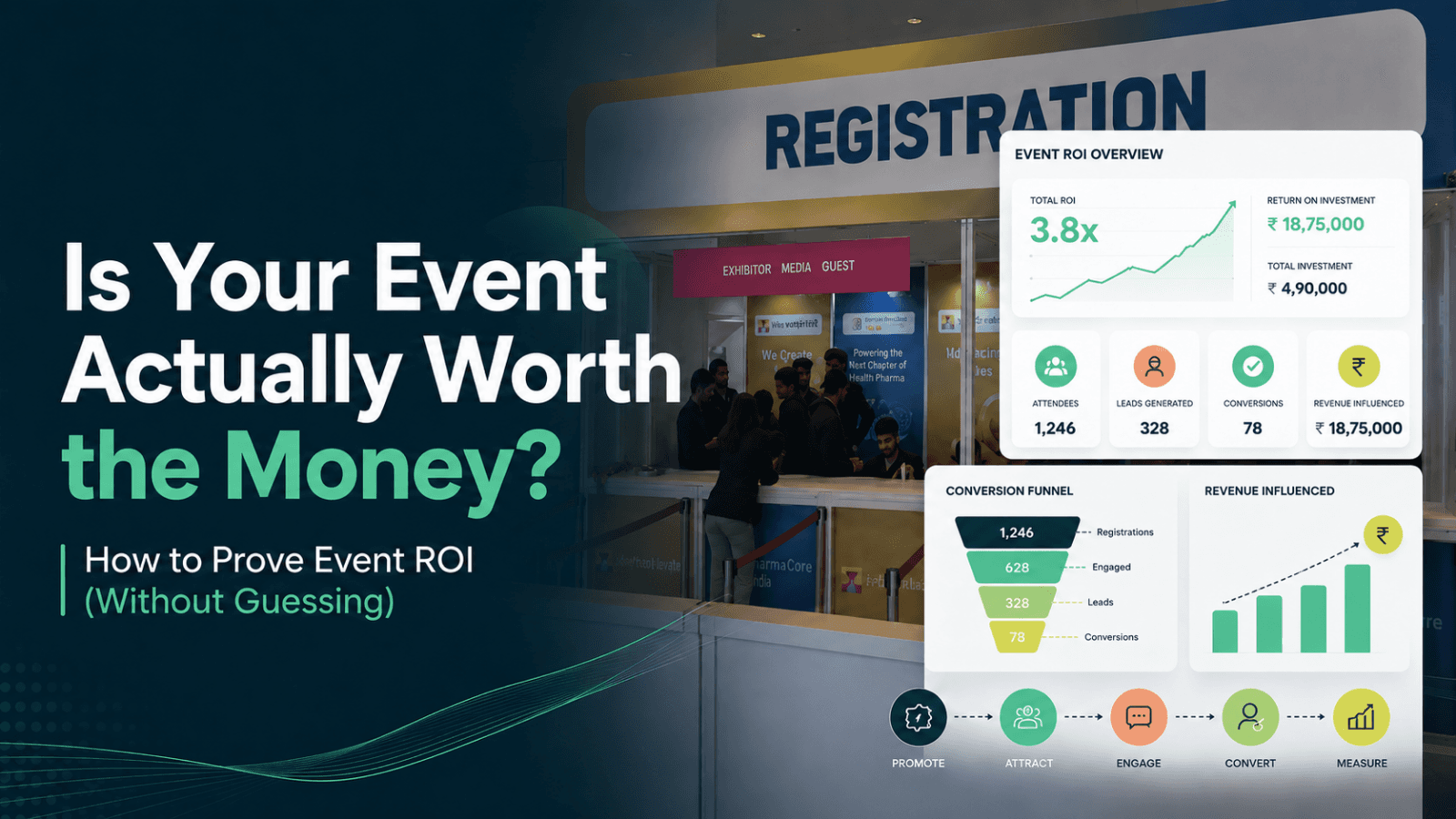
The conference is done. Booths are coming apart, people are dragging suitcases toward cabs, and everyone's mostly just relieved to be going home. It's been a three-day marathon and nobody's thinking about numbers yet, just a shower and their own bed. Most of the room leaves happy, without really knowing yet whether it actually worked. That clarity usually shows up a day or two later, when there's a message sitting in your inbox asking for a recap. Somewhere in that thread comes the question you knew was coming: great turnout, but what did we actually get out of it?
You spent ₹40 lakh, maybe more. Two thousand people came through the door across two days. The agenda ran on time, the stage looked the way you pictured it back in March. Here's the thing, though: events now eat somewhere between a quarter and a third of most marketing budgets, and once a spend gets that big, "it went well" stops being an answer anyone accepts. It's a real number now, so it needs a real number back.
What Does Event ROI Actually Mean Beyond Attendance Numbers?
Attendance tells you how many people walked in. It doesn't tell you what changed because they did. That's really the whole shift happening in events right now: measurement is moving away from headcount and toward things like engagement quality, connections that turned into something, and outcomes that show up weeks later, not on the day itself.
Here's the formula almost every serious ROI framework comes back to:
Event ROI = (Event Revenue − Event Expenses) ÷ Event Expenses
The part people usually get wrong is "revenue." For most conferences, that's not just ticket sales. It's anything you can trace back to the event: a deal that started there, a sponsor who renewed because of it, a procurement saving from a vendor you negotiated harder with because you knew exactly what you needed.
The core five metrics to track, whatever the size of the event:
Attendee-to-action conversion, the percentage who completed the specific thing the event was built to drive (demo booked, membership renewed, trial started)
Session engagement, the percentage attending three or more sessions
Sponsor and partner lead quality, direct feedback from sponsors on whether the leads were actually usableAttendee satisfaction, usually captured as NPS
Cost per attendee, total spend divided by headcount
What Are the Most Common Event ROI Mistakes at Each Event Size?
The trap changes shape as the event grows. Here's what to watch for at each stage:
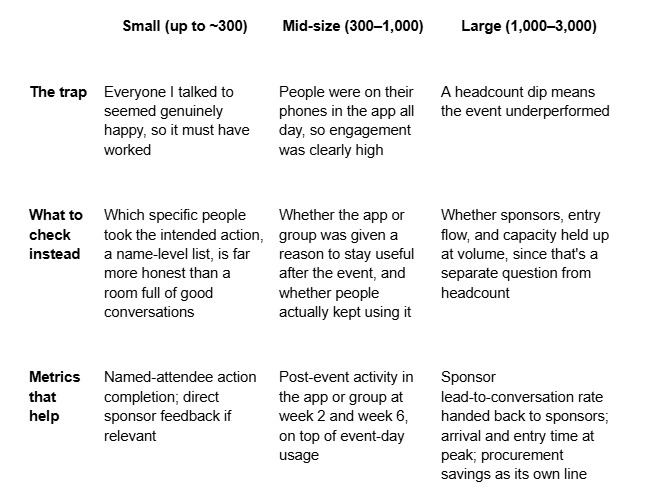
That mid-size trap is worth sitting with for a second. On-site app usage is easy to see, and easy to mistake for community. Someone opening an app while they're already sitting in the room says very little about whether they'll ever open it again once they've gone home. Continuity has to be designed for on purpose, or it simply doesn't happen. Leave it to chance, and the app goes quiet the second the event ends, no matter how good the data looked on the day.
Here's what actually works instead: a plan for something to happen in that app around week two, giving people an actual reason to check back in. People come back for unfinished business far more reliably than they come back to browse an archive. A slide deck gets opened once, maybe twice, and that's it.
Take a medical conference as an example. A cardiologist asks a sharp question during Q&A, and the speaker only half-answers it because time runs out. Two weeks later, the speaker posts a full written answer in the app, tagged to that exact session. The cardiologist gets a notification, opens it, and now has a real clinical answer in their pocket that they couldn't have gotten anywhere else. Multiply that by twenty unresolved questions across a three-day event, and the app stops feeling like a leftover and starts becoming a small, growing reference that's actually specific to that community, the kind of thing worth checking again next month when a similar case comes up.
How Should You Structure an Event Budget Around ROI Goals?
Most event budgets get built in roughly the same order: venue first, production second, food third, with whatever's left over going to technology and measurement. What the event is actually meant to achieve tends to come up only after most of the money's already spoken for.
Flip that order and the whole event gets sharper. Start with the objective: reduce arrival friction, capture accurate attendance data, improve sponsor ROI, lift engagement. Then run every line item through a simple filter: does this meaningfully move one of those objectives, or is it nice to have but skippable if things get tight? Even with a generous budget, this forces real trade-offs, and every rupee ends up defending something specific instead of sitting in a familiar line item just because that's where it's always gone.
Matching features to real objectives
Here's a test worth running on literally every feature on your event stack: can you say, in one sentence, why you're using it? If the honest answer is "it sounded good in the sales call," that's a feature you're paying for twice, once to buy it, and again when someone eventually asks what it did.
Take AI-based matchmaking. The objective might be that attendees leave with a handful of genuinely relevant connections instead of wandering a room full of strangers. Proving it worked takes real data: the match-acceptance rate, how many suggested meetings actually happened, and a follow-up a few weeks out to see if any of them turned into something. Skip that data and you're guessing, no matter how good the feature felt on the day.
Same logic applies to badge scanning for exhibitors. The objective there is measurable leads. The proof shows up in the lead report handed to sponsors afterward, specifically how many scans converted into real conversations, how that stacks up against what they'd have captured manually, and whether they come back and renew based on those numbers next year.
Do procurement savings count toward event ROI?
There's a form of value that almost never makes it into the post-event report: money saved because someone on the team actually knew what they were negotiating. A better rate locked in with a vendor. A fee avoided because a contract clause was written properly the first time. This is real money, and it's easy to prove the same ordinary way any procurement saving gets proved. Keep the original quote next to the final signed rate. Compare the difference against last year's price, or against two other quotes for the same service.
This one's worth doing on purpose, because it's one of the few ROI stories that doesn't depend on attendee behaviour or survey results. It's a number on an invoice sitting next to a number on an earlier quote. If you're building a case for next year's budget, this is one of the easier wins to bring to the table, because nobody has to take your word for it.
How Do You Prove an Event Was Worth the Investment?
Most people dread that post-event recap email, and honestly, that's true regardless of how well things went. That's just what it feels like handing months of work over for someone else to judge. It's also worth saying plainly that some of this sits outside anyone's control. A storm can keep half your registered list at home. A competitor can schedule something the same week. That doesn't mean the event failed, and measuring it as if every outcome was fully in the organiser's hands isn't fair.
The fix is setting objectives properly before the event happens, rather than reconstructing them afterward to match whatever occurred. A framework worth running every time, call it the objective-ownership check:
Get the real objectives on the table early, with the people who'll actually judge the event. "Make it a success" is a mood, not an objective. Sit down with whoever's going to ask the ROI question later and land on two or three things that are genuinely specific: arrival wait times under a set threshold, a target number of qualified sponsor leads, a percentage of attendees hitting three or more sessions.
Separate what you're accountable for from what's out of your hands. Session design, registration flow, and sponsor matching are yours. Weather and travel disruptions aren't. When a storm cuts attendance, the honest report reads something like "engagement for the people who attended hit target; turnout was affected by conditions outside our control." That distinction only exists if someone drew the line before the event started.
Give each objective an actual owner, not just the event as a whole. "Improve sponsor ROI" quietly becomes nobody's job the moment the event gets busy, unless one specific person owns the data behind it.
Check the objectives while the event is still running. A quick look at registration-to-arrival conversion on day one, or session attendance by day two, tells you if you're on track while there's still time to fix something.
Do that groundwork, and the after-event conversation stops being a guessing game. It turns into walking through what was set out to achieve, what the data actually shows against each point, and being able to explain, with evidence, anywhere something outside your control moved the numbers.
Frequently Asked Questions
How do I calculate ROI on a conference? Use the standard formula: (event revenue − event expenses) ÷ event expenses. For most conferences, revenue includes anything traceable to the event, including closed deals, sponsor renewals, and procurement savings.
How do I prove an event was successful to leadership? Bring outcomes tied to the goals set beforehand. One well-documented example, a specific lead, a specific saving, tends to land better than a table of metrics.
What KPIs should I actually track? Session engagement, lead quality, sponsor-reported value, connections that continued afterward, and completion of the one action the event was built to drive.
What's the difference between ROI, ROE, and ROO? ROI (Return on Investment) is financial return measured against cost. ROE gets used inconsistently across the industry — sometimes "return on engagement," sometimes "return on experience" — but it always covers the harder-to-quantify stuff: satisfaction, connection, sentiment. ROO (Return on Objectives) applies when the event never had a revenue goal to begin with: did it hit what it was actually built to achieve.
How do I know if my annual event is still worth running? Check whether relationships, revenue, or community actually carried on after it ended. An event that resets to zero every year is a weaker asset than one that compounds.
That inbox message is still going to show up, storm or no storm, sponsors or no sponsors. The difference is what happens when you open it. Walk in with a name-level list, a lead report, a saved quote next to an old one, and the recap turns from a verdict you're waiting for into a conversation you're actually driving.
Sources referenced: event ROI formula and budget-share benchmarks via Cvent's event ROI guide and Gable's 2026 event ROI framework; ROI/ROE/ROO terminology via industry coverage from PCMA, EventMB, and Ticket Fairy's 2026 conference ROI playbook.
Written from the day-to-day of building the registration, badging, and engagement tools event ROI actually gets measured on. If you're building your own ROI report, TicketRoot's data (registration, attendance, session behaviour, lead capture, access scans) is usually most of what you need to answer the question directly.
Running an event and need a secure, trusted platform? Talk to TicketRoot →