
What Fintech Event Attendees Complain About Most (And How to Fix It)
See how India InsurTech Summit 2026 used connected registration, QR check-in, onsite badging, a live event app and collection tracking to keep a packed one-day BFSI conference moving.
A fintech or insurtech conference can put an insurer, a regulator, a founder and an investor in the same room for one day.
That opportunity is difficult to create and surprisingly easy to waste.
A slow entry line, a badge correction that moves between desks, an outdated agenda or an unclear collection process does more than create friction. It takes minutes away from meetings, evaluations and decisions that may not happen again once the room disperses.
Keeping the event moving means removing avoidable pauses across check-in, badging and information access, so the limited time inside the venue is spent on decisions and conversations, not administrative friction.
Click here to view the event:
The quick answer
A fintech event should move quickly wherever delay adds no value: through registration, entry, badge printing and access to agenda information.
Speed, in this context, means routine actions are short and reliable, so attendees spend more of the day in conversations that matter instead of queues or corrections. This is increasingly what organisers mean when they search for the best event registration and badge printing software: not two separate systems, but one.
Why are lost minutes more expensive in this room?
Fintech and insurtech conferences often bring together people who do not regularly share the same room: insurers, startups, regulators and investors, each moving through the day with a different objective and a different schedule.
Investors often have only a handful of meetings to work with, and a regulator or senior executive may be present for only part of the programme. The event creates value by making those crossings possible within a narrow window.
The official India InsurTech Summit 2026 agenda, for example, ran from 8:00 a.m. to 7:00 p.m. with 12+ sessions across masterclasses, keynotes, panels, firesides and demos. That density makes every transition part of the event's design worth planning for rather than leaving to chance.
Where does a fintech event usually slow down?
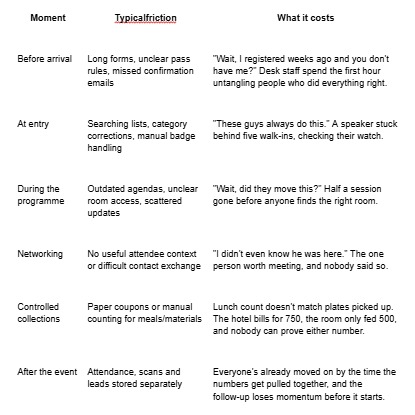
Start by separating the standard flow from the exception flow
The fastest registration desk moves standard cases through a short, predictable path and gives exceptions (walk-ins, corrections, upgrades) a separate route to be resolved without slowing everyone else down.
A valid pre-registered attendee should be able to scan, verify and receive the correct badge quickly. A walk-in, spelling correction, pass upgrade, speaker issue or organiser request needs a staffed exception route instead. Mixing both groups in one line makes the common journey as slow as the most complicated case.
A connected registration and ticketing workflow can apply different forms, approvals, categories and messages before people reach the venue.
Registration benchmarks bear this out at scale: organizers commonly plan around 90% attendance, when documented turnout typically runs closer to 60 to 70 percent. Badge stock can be planned more generously, at 90 to 95 percent of registrations, since over-producing badges costs far less than over-producing meals. Build the standard-vs-exception split around that gap, not around the optimistic number.
The badge must resolve identity at a glance
At a mixed-industry conference, the badge helps people make fast judgements: who is this person, which organisation are they from, and what role do they have at the event? A badge that is delayed, inaccurate or difficult to read slows both access and networking. In vendor terms, this is exactly what event accreditation software is built to solve: identity resolved at a glance, not after a delay at the desk.
Onsite printing is especially useful where registrations remain open, speaker or organiser records change, or multiple pass categories need different badge templates.
The check-in record and badge should stay connected so a correction is made once, not repeated across a spreadsheet, printer queue and reporting file.
A well-set-up on-demand printing station prints a badge in well under ten seconds, meaning a single printer-and-laptop lane can clear roughly 150 to 200 people in the first busy half hour. That's the number any conference badge printing software has to be judged against, not headcount alone.
TicketRoot's check-in and badging setup, event check-in software with QR badges at its core, connects attendee validation, category logic and onsite badge printing.
The event app should answer "what happens next?"
A dense one-day agenda changes quickly. A session moves, a speaker order changes, a room fills, or a photograph becomes available, often within the same hour. Attendees should not have to find a printed board or search an old email every time the day changes.
An event app is most useful when it works as a live operating layer, giving attendees the current agenda, session updates and access to event photographs. It should reduce repeated questions for the onsite team while giving attendees a clear next action.
See how TicketRoot structures an event app around agenda, communication, networking, participation and event content, the same checklist worth using when comparing the best event app for conferences generally.
A real example InsurTech Summit 2026
At India InsurTech Summit 2026, an AI and digital-transformation conference organised by The Digital Fifth on 15 July, the agenda was exactly the kind of compressed day this article has been describing. Insurers, regulators, investors and BFSI leaders moved through keynotes, panels, masterclasses and product showcases across Gold Pass, Organiser and Speaker categories, all inside one day.
The operational goal was to keep registration, check-in, badging, agenda access, photo delivery and lunch collection all reading from the same record, instead of stitching separate systems together after the fact.
TicketRoot, one of the event technology companies in India built specifically around this kind of dense, single-day programme, carried attendee data from signup through arrival, so badges printed correct by category without a fix needed at the desk. The event app replaced a printed agenda board with live updates and same-day photo access, and even the lunch queue ran through the same system, each plate collection scanned against the attendee's actual entitlement rather than tracked by coupon and clipboard.
By the end of the day, TicketRoot had tracked over 800 orders, more than 600 check-ins and around 750 lunch entitlements against close to 330 logged collections. What mattered wasn't the numbers themselves, but that they all lived in one operating record, letting the organiser see arrivals, badging and collections as they happened, instead of reconstructing the day afterward from separate exports. The 330-against-750 gap, for what it's worth, tracks closely with the wider 60 to 70 percent documented-turnout benchmark above, a sign the system was capturing reality, not just activity.
Speed needs reliability behind it
A fast scan that fails under peak load is not useful, and neither is an app showing yesterday's agenda or a badge printer with no exception process. The aim is dependable movement, not a headline number.
For a fintech or insurtech event, reliability should be tested end-to-end: hardware and connectivity, staff roles and escalation paths, and the live reporting that shows what's actually happening on the ground. This is the real gap between event management software with on-site support and a system that only works from a laptop in the back office. The checklist below breaks this down further. The system is ready when the team knows what happens both in the standard case and when something changes.
What should the organiser be able to see live?
A live operating view exists to answer a few practical questions in the moment: how many people have arrived against how many were expected, and where exceptions are building up. Everything else (which sessions need attention, whether controlled items have been collected) follows from having those two numbers visible in real time.
A connected dashboard and reporting layer helps the organiser act during the event and export a cleaner record afterwards.
A practical checklist, in order
Before the event
Define attendee and pass categories before the registration form is built
Connect badge templates directly to attendee categories
Decide which sessions, meals, materials or zones require a recorded scan
Prepare devices, printers, stock, power, connectivity and offline fallback
The week of
Test the complete scan-to-print journey at expected peak volume. Plan lane count against the roughly 150 to 200 people per half hour figure above, not against total headcount
Give onsite staff clear ownership for registration, technical support and exceptions
On the day
Review live check-ins and controlled collections during the event, not only afterwards
Confirm how attendance and engagement records will be handed over for follow-up
Planning a fintech, insurance or BFSI conference, or just comparing event registration software for conferences in India right now? Share the event flow with TicketRoot to map registration, check-in, badge printing, app communication and onsite scanning around the actual programme.
Upcoming BFSI events in Q4 2026
The same pressure continues across the BFSI calendar: busy agendas, senior attendees and limited time at the venue.
A few upcoming events:
Credit & Collections Summit India: 7 to 8 Oct 2026, Radisson Blu Mumbai International Airport
NBFC Connect Leaders' Retreat 2026: 9 to 11 Oct 2026, The Radisson Resort & Spa, Lonavala
BFSIInsight Summit: 26 to 28 Oct 2026, Jio World Convention Centre, Mumbai
Different formats, same need: keep registration, attendee movement and event operations moving without slowing the day down.
Frequently asked questions
What makes fintech event operations different from a general conference?
Fintech events compress far more distinct objectives into a single day than a general conference does. Regulators, insurers and investors are often moving through the same rooms on different schedules, which makes accurate categories and a short exception path matter more than usual. At India InsurTech Summit (IIS) 2026, for example, a single 8:00 a.m.-to-7:00 p.m. day covered 12+ sessions across masterclasses, keynotes, panels and demos.
Should every attendee use the same check-in route?
No. Standard pre-registered attendees get a short check-in path with quick validation, while walk-ins, corrections, upgrades and special cases move to a separate exception desk instead.
Can QR scanning be used beyond entry?
Yes, at India InsurTech Summit (IIS) 2026, QR scanning was used for lunch plate counts as well as entry, recording collections against each attendee's entitlement instead of relying on manual counting alone. The same approach can extend to session attendance or material pickup, as long as the purpose and privacy notice are clear to attendees. This is the exact workflow that session tracking software for conferences is designed around.
What technology does a fintech event need for registration and check-in?
The core setup is a connected registration platform, an onsite check-in system, and category-based badge printing, with an event app extending that same record to live agenda updates and QR scanning covering additional touchpoints like meal collection. At India InsurTech Summit (IIS) 2026, this ran as one connected system: registration, check-in, badging, agenda access and lunch scanning were all tracked together rather than as separate tools. For teams evaluating Cvent alternatives with hands-on, on-ground event technology, this is usually the deciding factor: whether day-of support is built into the platform or bolted on separately.
None of this shows up on the agenda. It's not a session, not a keynote, not a name badge in a photo. But it's the reason a regulator on a tight schedule made it to their 2 p.m. meeting, and the reason an investor got three extra minutes with a founder instead of standing in a badge line. That's what a fast-moving room actually buys you: not a faster event, just more of it spent on the conversations it was built for.
Watch how it ran on the day → 2-minute recap: India InsurTech Summit 2026 check-in in action
Running an event and need a secure, trusted platform? Talk to TicketRoot →